
What Makes Rosemary Work?
For most of my life, rosemary was just a cooking herb.
It was the thing that went on roasted potatoes, chicken, and holiday dinners. I knew it smelled good, and I knew it was one of those herbs that everyone seemed to grow because it was useful in the kitchen.
What I didn't realize was that rosemary has one of the most interesting chemical profiles in the herbal world.
In fact, if chamomile is often thought of as a calming herb and lavender is known for relaxation, rosemary almost feels like their opposite. Traditional herbalists have long associated rosemary with memory, concentration, circulation, and mental clarity. Even old herbal texts contain references to rosemary's connection with remembrance and clear thinking.
For a long time, I assumed that was mostly folklore.
Then I started looking at the chemistry.
The more I learned, the more I realized that rosemary's traditional reputation isn't random. Like many medicinal herbs, its uses begin to make much more sense once you understand what compounds are inside the plant.
Rosemary Is Built Around Aromatic Chemistry
Like lavender, rosemary belongs to the mint family, known as Lamiaceae.
Members of this family are famous for producing aromatic compounds. Mint, thyme, oregano, sage, basil, and lavender all owe much of their medicinal activity to various terpenes and volatile constituents.
Rosemary is no exception.
If you've ever rubbed a rosemary leaf between your fingers, you've immediately experienced this chemistry. That sharp, resinous scent comes from a collection of compounds stored within the leaves.
Some of the most important include:
1,8-cineole
Camphor
Borneol
α-pinene
Rosmarinic acid
Carnosic acid
Carnosol
What's fascinating is that rosemary contains both aromatic terpenes and powerful antioxidant compounds. This gives it a wider range of activity than many people realize.
The Compound Behind Rosemary's Reputation for Mental Clarity
One of the most studied compounds in rosemary is 1,8-cineole, sometimes called eucalyptol.
This compound is also found in eucalyptus and several other aromatic plants. Researchers became interested in it because of its apparent effects on cognition and mental performance.
Several studies have found associations between rosemary aroma, circulating levels of 1,8-cineole, and improved performance on certain memory and concentration tasks.
Now, that doesn't mean rosemary turns people into geniuses.
But it does suggest that some of the traditional associations between rosemary and mental clarity may have a biological basis.
One reason this is so interesting is that rosemary has been connected to memory for centuries. Long before anyone knew what 1,8-cineole was, people were already associating rosemary with remembrance.
The chemistry doesn't prove the folklore, but it does make it harder to dismiss.
Rosmarinic Acid: The Compound That Shows Up Everywhere
While 1,8-cineole gets attention for cognitive effects, rosmarinic acid may be the most important compound from a broader herbal perspective.
Despite its name, rosmarinic acid isn't unique to rosemary. It's found throughout the mint family and appears in herbs such as lemon balm, basil, sage, and peppermint.
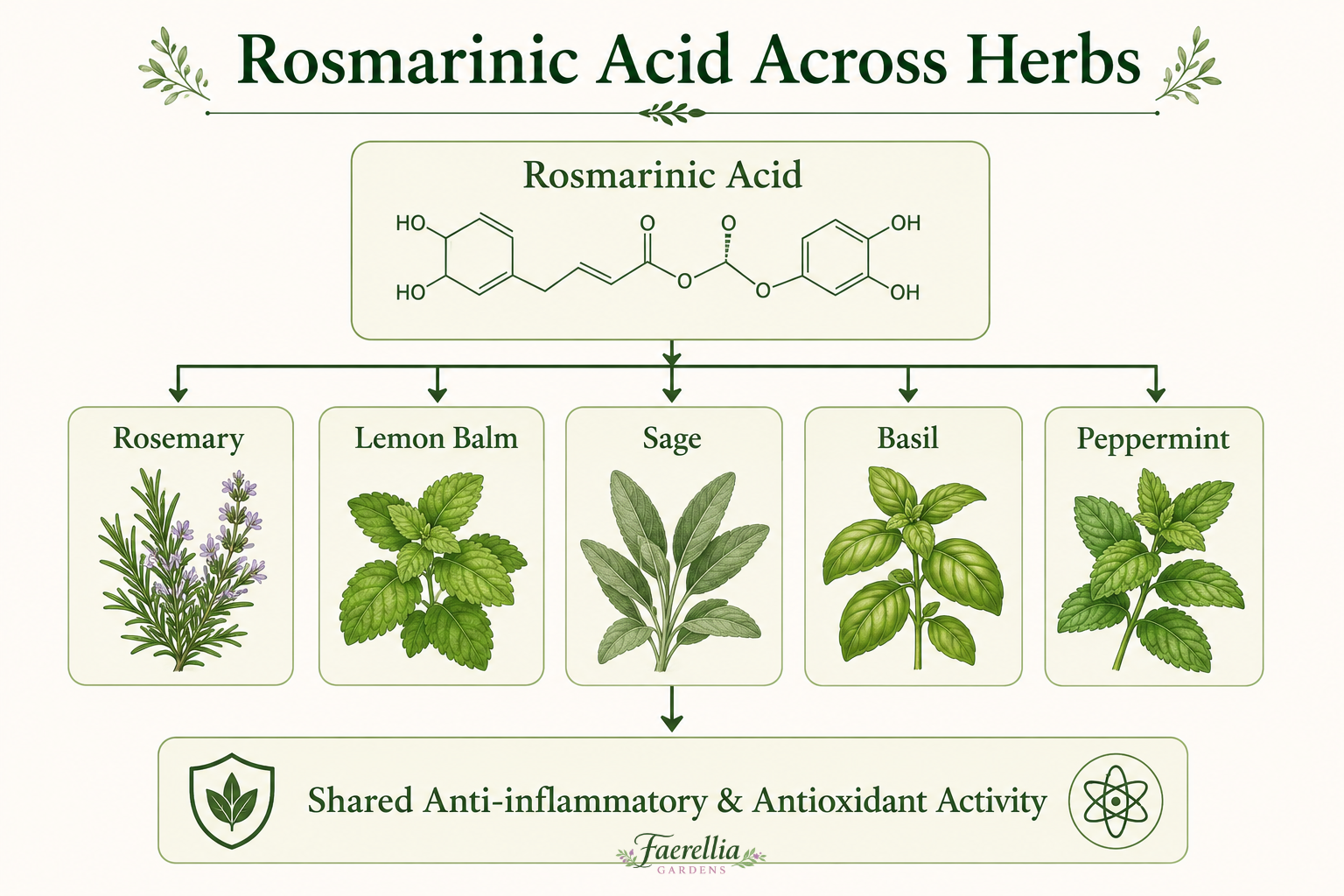
Researchers are interested in rosmarinic acid because it appears to possess both antioxidant and anti-inflammatory properties.
To understand why that matters, we need to talk about oxidative stress.
Every cell in the body is constantly producing reactive molecules as part of normal metabolism. Left unchecked, these molecules can damage proteins, fats, and DNA.
Plants face the same problem.
Rosmarinic acid appears to help protect plant tissues from this type of damage. When humans consume rosemary, researchers believe some of those protective properties may carry over.
This is one reason rosemary often appears in discussions of healthy aging, brain health, and inflammation.
Carnosic Acid: Rosemary's Secret Weapon
If I had to pick the compound that surprised me most while studying rosemary, it would probably be carnosic acid.
Carnosic acid is a powerful antioxidant found primarily in rosemary and a few closely related plants.
What's interesting is that it appears to activate some of the body's own antioxidant defense systems.
In other words, instead of simply acting as an antioxidant itself, it may encourage the body to increase its own protective mechanisms.
Researchers have become particularly interested in this compound because of its potential role in protecting nervous system tissues from oxidative stress.
While much of this research is still developing, it helps explain why rosemary continues to attract attention from scientists studying brain health and aging.
Why Rosemary Feels Different Than Lavender
One thing that fascinated me while studying both herbs is that rosemary and lavender belong to the same family but feel completely different.
Lavender is associated with relaxation.
Rosemary is associated with alertness.
The difference comes down largely to chemistry.
Lavender produces large amounts of linalool and linalyl acetate, compounds associated with relaxation.
Rosemary produces larger amounts of compounds such as 1,8-cineole, camphor, and borneol.
Different chemistry.
Different effects.
This was one of the moments when herbalism started making more sense to me. Traditional herbal actions stopped feeling arbitrary and started feeling connected to the actual chemistry of the plant.
Why Herbalists Use the Whole Herb
Just like chamomile and lavender, rosemary doesn't come down to one compound.
1,8-cineole contributes to its aromatic effects.
Rosmarinic acid contributes antioxidant and anti-inflammatory activity.
Carnosic acid adds another layer.
Dozens of additional compounds contribute their own effects.
Together they create the herb we know as rosemary.
The more I learn about medicinal plants, the less interested I become in finding a single active ingredient. Plants are systems. Their effects often emerge from many compounds working together rather than one compound acting alone.
When I look at a rosemary plant now, I don't just see a culinary herb.
I see a plant packed with compounds that help explain centuries of traditional use for memory, concentration, circulation, and overall vitality.
And honestly, that's a lot more interesting than a seasoning for roasted potatoes.