
What Makes Lavender Work?
For a long time, I thought lavender's medicinal reputation came down to one simple fact: it smells nice.
That probably sounds ridiculous, but if you ask most people why lavender is relaxing, you'll get some variation of the same answer.
"It just is."
It's in soaps, candles, lotions, bath products, teas, linen sprays, sleep sprays, and practically every product marketed toward stress relief. Lavender has become so closely associated with relaxation that we almost stop questioning it.
But as I started learning more about herbalism, I found myself asking the same question I asked about chamomile.
Why lavender?
Why does this particular plant have such a strong reputation for helping people relax?
As it turns out, the answer isn't just that lavender smells pleasant. The answer lies in a collection of compounds that the plant produces for its own survival but which also happen to interact with the human nervous system in fascinating ways.
Once I started looking at the chemistry, lavender became a lot more interesting than a nice-smelling flower.
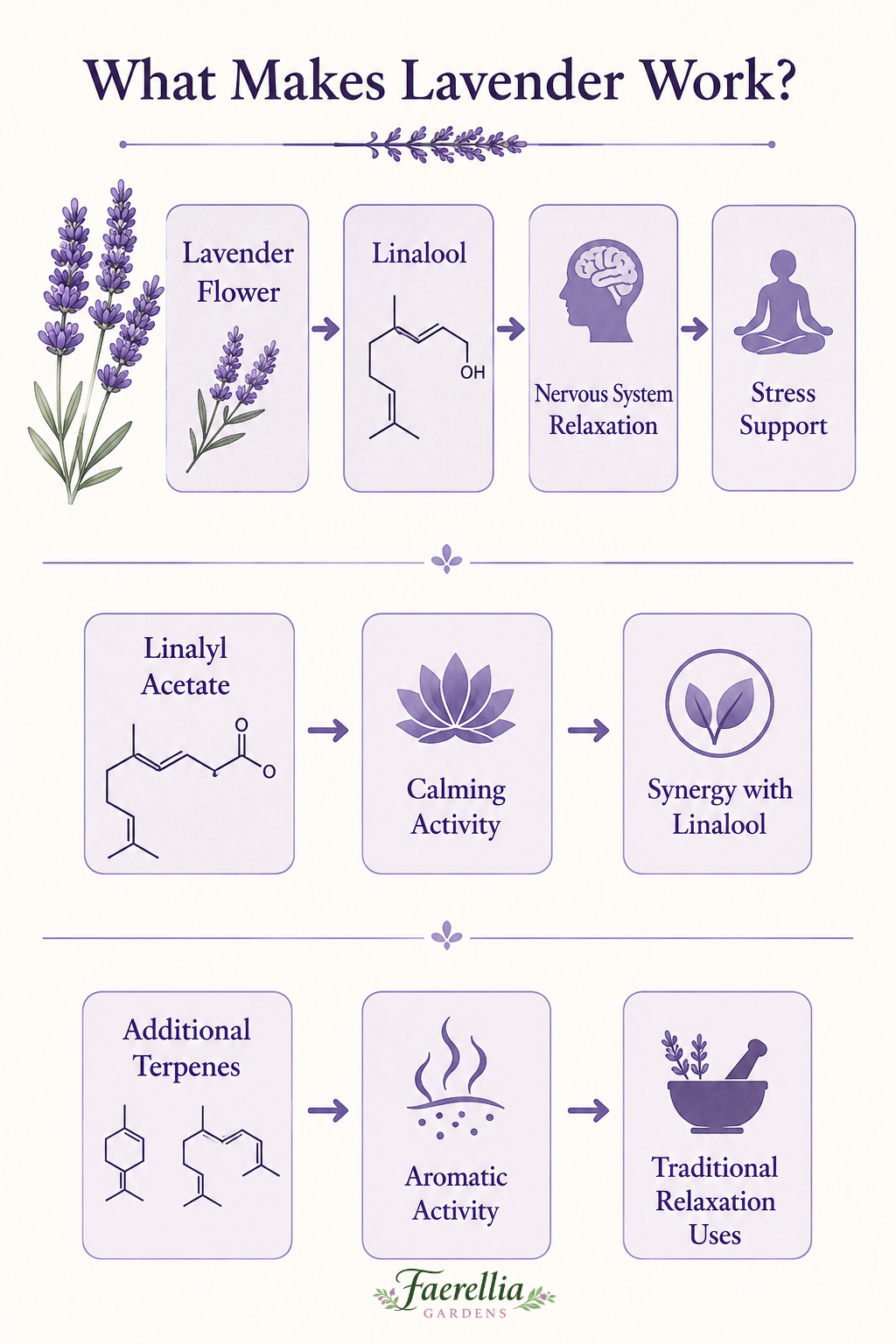
Lavender Is an Aromatic Plant First
One of the first things I learned while studying medicinal plants is that not all herbs are built around the same chemistry.
Chamomile is rich in flavonoids and anti-inflammatory compounds.
Marshmallow is known for its mucilage.
Echinacea contains alkylamides.
Lavender, on the other hand, is primarily an aromatic herb.
When you brush against a lavender plant and immediately smell that unmistakable fragrance, you're experiencing a collection of volatile compounds evaporating into the air.
Those compounds are not there for our benefit.
The plant produces them as part of its own defense and survival strategy.
Many aromatic compounds help deter insects, protect against pathogens, reduce herbivore damage, or attract pollinators. The fact that they also affect human physiology appears to be a fortunate coincidence.
In lavender, two compounds stand out above all the others.
Linalool and linalyl acetate.
Meet Linalool: Lavender's Most Studied Compound
If chamomile's star compound is apigenin, lavender's is probably linalool.
Linalool is a terpene alcohol found in many aromatic plants, including lavender, basil, coriander, and some citrus species. It's largely responsible for the characteristic scent that most people associate with lavender.
Researchers became interested in linalool because of its apparent effects on the nervous system.
Several studies suggest that linalool may influence neurotransmitter activity and help regulate nervous system excitability. While the exact mechanisms are still being studied, evidence suggests that linalool may influence GABA signaling, glutamate signaling, and other pathways involved in stress and relaxation.
The important takeaway is that linalool appears to help reduce excessive nervous system stimulation.
That's a much more useful way to think about lavender than simply saying it's calming.
The nervous system is constantly receiving information. Sometimes that's helpful. Sometimes it becomes overwhelming.
Compounds like linalool appear to help shift the balance back toward a more relaxed state.
That's one reason lavender often feels different from a sedative.
It doesn't typically force sleep.
Instead, it seems to make relaxation easier.
Why Smelling Lavender Can Actually Matter
One thing that surprised me when I started studying lavender was how much of its traditional use revolves around aroma.
Most medicinal herbs are consumed.
Lavender is unusual because simply smelling it may have measurable effects.
When you inhale lavender's aromatic compounds, those molecules interact with receptors in the nasal cavity. Signals are then sent directly to areas of the brain involved in memory, emotion, and autonomic nervous system regulation.
This is one reason scent can feel so powerful.
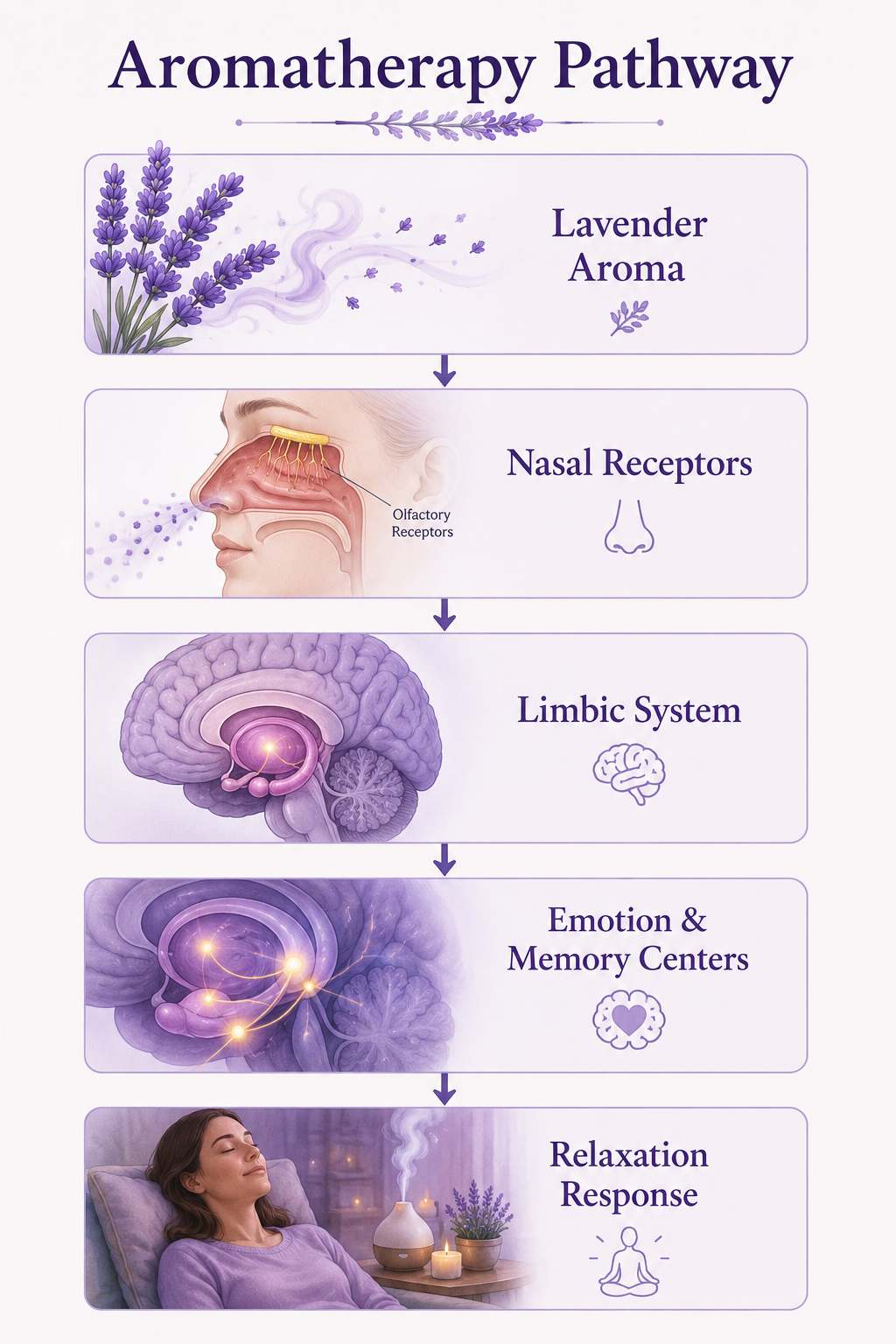
A smell doesn't need to travel through the digestive system before affecting the brain. The connection is much more direct.
Researchers believe this may help explain why lavender aromatherapy has been studied for stress, anxiety, and sleep quality.
In other words, when herbalists recommend putting lavender in a pillow, bath, or sachet, it isn't necessarily just tradition.
There may be real physiological reasons why those practices developed.
Linalyl Acetate: The Compound Working Alongside Linalool
Linalool gets most of the attention, but it doesn't work alone.
Lavender also contains significant amounts of linalyl acetate, another major terpene-derived constituent.
Researchers believe linalyl acetate may contribute to many of lavender's relaxing effects and may work synergistically with linalool.
This is a pattern you'll see throughout herbalism.
People often want to find the one active ingredient responsible for everything.
Plants rarely cooperate with that idea.
Instead, they tend to contain groups of compounds that interact with each other.
Trying to understand lavender by focusing only on linalool would be a little like trying to understand an orchestra by listening only to the violins.
You'd hear part of the music, but not the whole performance.
Lavender Is More Than a Nervous System Herb
Most people know lavender for stress and sleep support, but that's only part of the story.
Traditional herbalists have also used lavender for minor wounds, insect bites, headaches, muscle tension, and digestive complaints.
The chemistry helps explain some of these uses.
Many of lavender's terpenes appear to possess antimicrobial activity. In the plant, these compounds help protect against microbes and environmental threats.
Some of the same compounds also appear to influence inflammatory pathways in humans.
This doesn't mean lavender is going to replace modern medicine for infections or injuries. However, it does help explain why herbalists historically reached for lavender in situations involving irritation, minor skin concerns, and tissue discomfort.
Once again, the traditional uses start making more sense when viewed through the lens of plant chemistry.
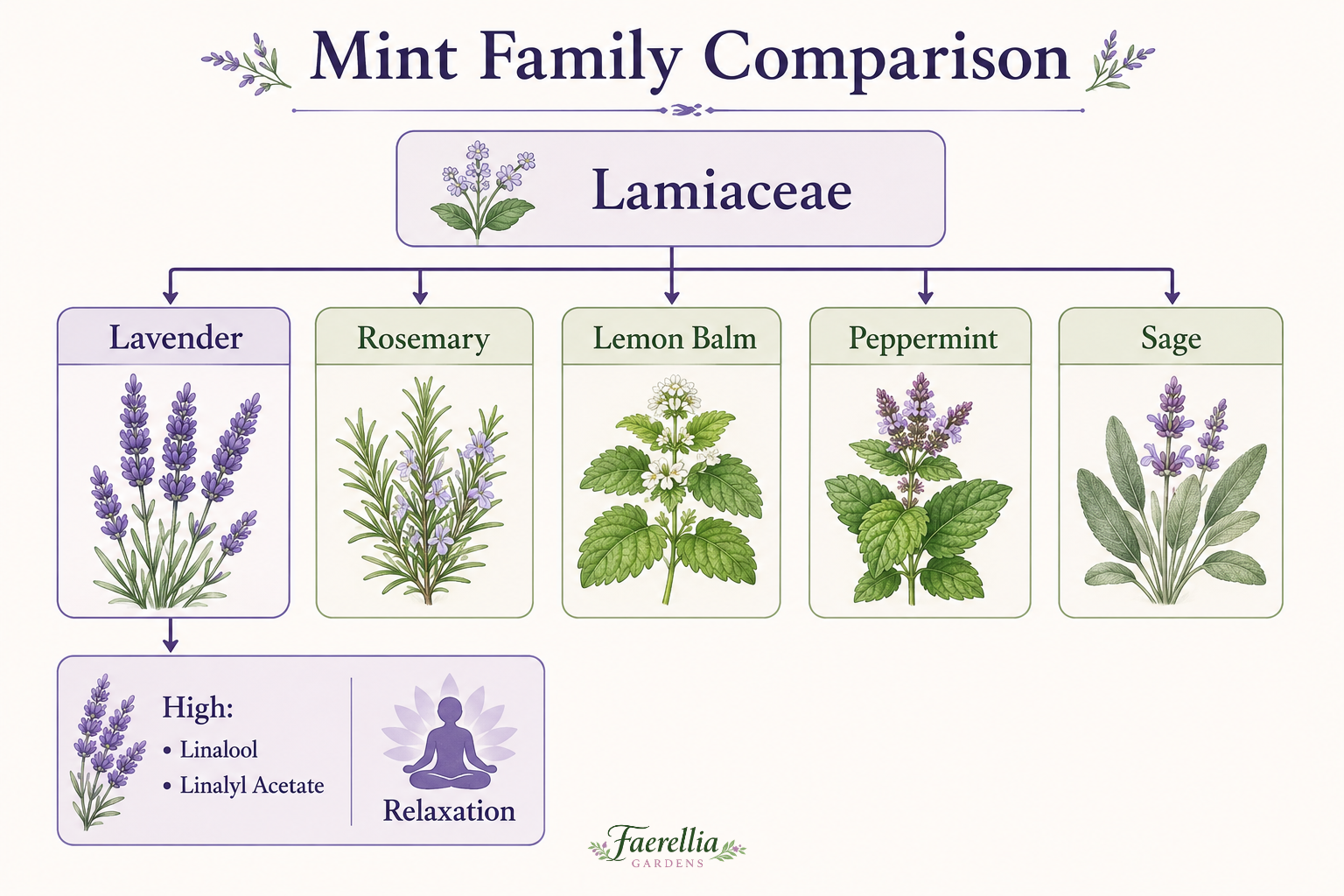
Why Lavender and Rosemary Smell Different
One thing I find fascinating is that lavender and rosemary belong to the same family.
Both are members of the mint family, Lamiaceae.
Yet they smell completely different.
The reason comes down to chemistry.
Lavender produces high levels of linalool and linalyl acetate.
Rosemary produces much larger amounts of compounds such as 1,8-cineole, camphor, and borneol.
Both plants use terpenes, but they're producing different terpenes.
That difference in chemistry helps explain why rosemary is often described as stimulating and mentally clarifying, while lavender is usually described as calming and relaxing.
The more I learn about herbalism, the more I realize that plant chemistry often explains traditional herbal actions surprisingly well.
Why Herbalists Use the Whole Herb
The biggest lesson I keep learning is that medicinal plants rarely come down to a single compound.
Linalool helps explain part of lavender's story.
Linalyl acetate explains another part.
Other terpenes contribute additional effects.
Together they create something more complex than any one constituent alone.
This is why herbalists often talk about synergy. The compounds in a plant evolved together and frequently appear to work together. The overall effect of the herb is often broader and more nuanced than what we'd expect from any isolated constituent.
When I first started studying lavender, I thought it was simply a pleasant-smelling flower that happened to be relaxing.
Now I see it differently.
Lavender is a sophisticated chemical factory producing compounds that help the plant survive and, quite accidentally, help us relax as well.
And honestly, I think that's a much more interesting story than simply saying lavender smells nice.