
The Crying Boy Painting: The Curse That Survived the Flames
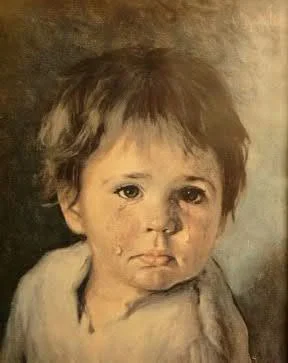
In September 1985, a house fire in South Yorkshire, England, started a story that would eventually convince people across Britain that a painting of a crying child could burn their homes to the ground.
The fire itself wasn't particularly mysterious. It started in the kitchen when a pan of cooking oil caught fire, and by the time it was extinguished, much of the downstairs had been badly damaged. But hanging in the living room, surrounded by the remains of the family's belongings, was a framed picture of a little boy with tears running down his face.
And apparently, the fire hadn't touched it.
What made this especially strange was that firefighters in the area claimed they had seen the same thing before. According to one station officer, he knew of approximately 50 house fires where pictures of crying children had been found among the ruins, sometimes without any visible damage.
Within days, the British newspaper The Sun was reporting on what it called the Curse of the Crying Boy. People began contacting the newspaper with their own experiences, and some were so frightened of the paintings that they tried to burn them, only to claim that the pictures wouldn't catch fire.
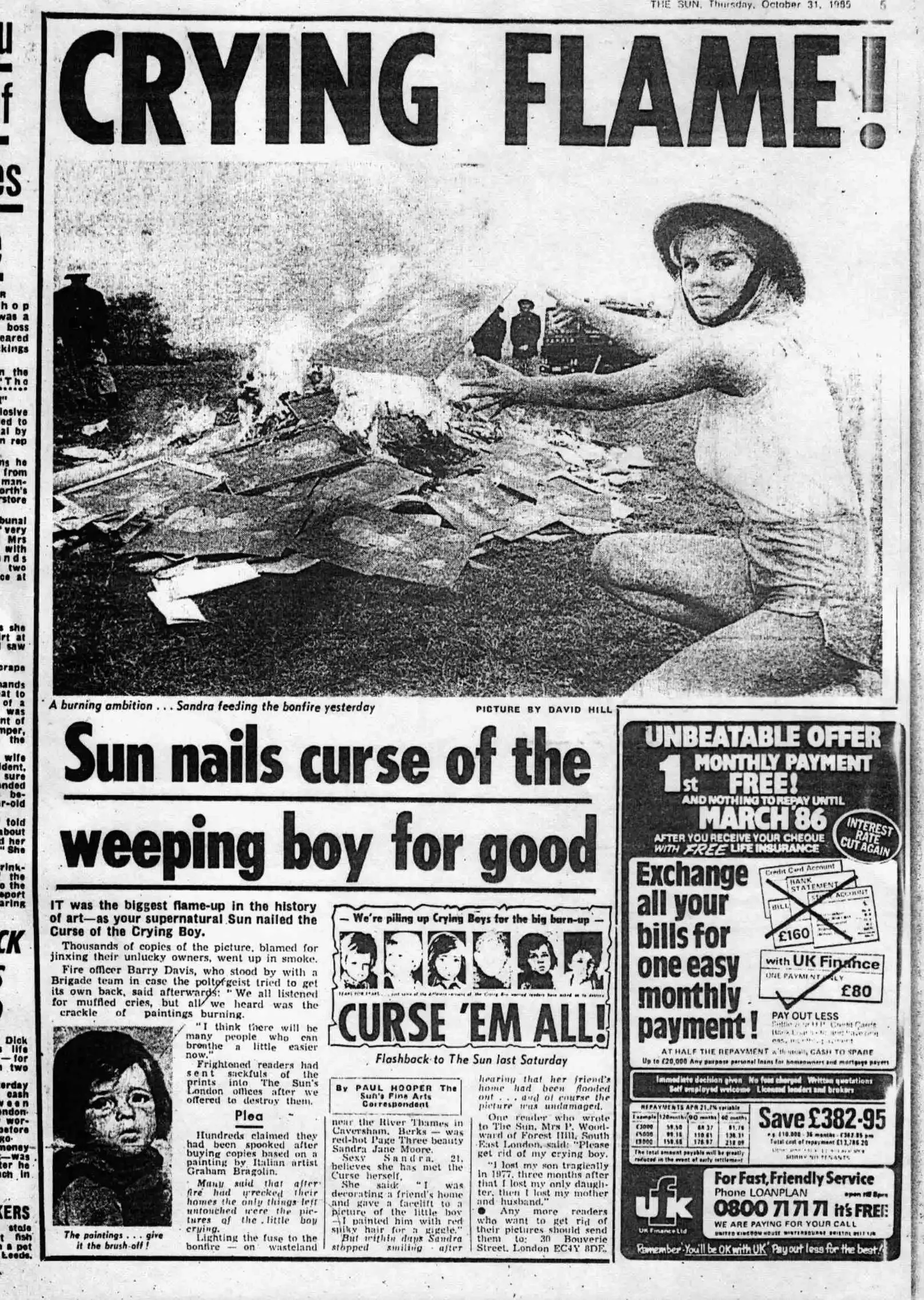
By Halloween, the newspaper had collected thousands of the prints and organized a public bonfire to destroy them.
But there's something about this story that makes it a little different from most cursed objects. We know when the supposed curse became national news, we know who reported some of the fires, and we even know who first introduced the idea that the painting was cursed.
And that last part becomes pretty important once we get into the history.
The Fire That Started It All
Our story begins in Swallownest, a mining village near Rotherham in South Yorkshire, where Ronald and May Hall lived in a terraced council house with their family.
On September 2, 1985, the local newspaper The Star published a report about a fire at their home. According to the article, the couple's 25-year-old son, David, had been cooking chips when the pan caught fire. The flames spread through the downstairs rooms, causing extensive damage, and David suffered burns to his arm.
Now, an accidental kitchen fire would normally have been a fairly routine story for a local newspaper, but the Hall family had something in their living room that caught the attention of the reporter.
It was a mass-produced print of a crying little boy, signed G. Bragolin.
Despite the damage around it, the picture was reportedly still hanging on the wall, apparently untouched by the flames.
The family believed the painting had something to do with their misfortune, and there was another detail that made the story more interesting. Ronald Hall's brother, Peter, was a firefighter, and one of Peter's colleagues claimed this wasn't the first time a picture like that had survived a serious house fire.
That colleague was station officer Alan Wilkinson.
Wilkinson had been with the fire service for decades, and according to later accounts, he had recorded approximately 50 fires involving Crying Boy pictures dating back to 1973.
Now, just so we're on the same page, that doesn't mean he believed the paintings started those fires. In fact, Wilkinson specifically rejected the idea that there was evidence of a supernatural cause. Most of the fires he knew about had perfectly ordinary explanations, including cooking accidents, cigarettes, and faulty or overheated heating equipment.
What he reportedly couldn't explain was why the pictures sometimes survived when the surrounding rooms were so badly damaged.
And that's what turned an ordinary house fire into a story that eventually spread across Britain.
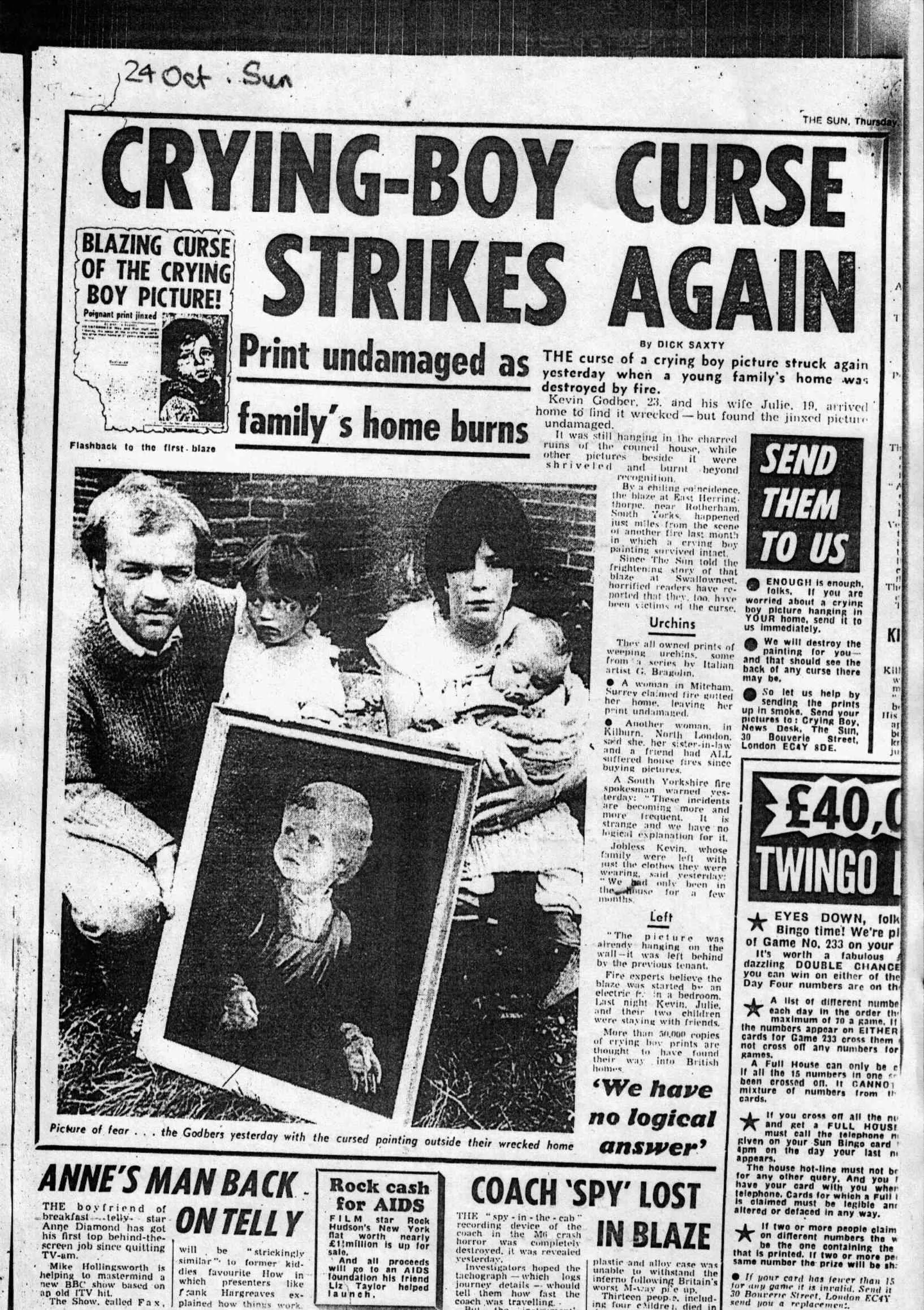
On September 4, The Sun published its own version of the Hall family's experience under the headline "Blazing Curse of the Crying Boy."
The next day, the newspaper reported that frightened readers were contacting its offices with stories about their own paintings.
And apparently, quite a few people had something to say.
The Other Fires
One of the people who contacted The Sun was Dora Mann, who lived in Mitcham, Surrey.
According to her account, she had purchased a Crying Boy print approximately six months before a fire devastated her home. She claimed that her other paintings had been destroyed, but the picture of the crying child survived.
Another woman, Sandra Craske of Kilburn in North Yorkshire, reported that she, her sister-in-law, and a friend had all experienced serious house fires after acquiring copies of the picture.
Then there was Brian Parks, whose family lived in Nottingham.
Parks reported that a fire had left his family homeless and that his wife and three children had required hospital treatment for smoke inhalation. When he returned to the damaged house, he reportedly found the Crying Boy still hanging on the blackened living room wall.
He said he destroyed the picture afterward.
These weren't the only reports. As the newspaper continued covering the supposed curse, more people came forward claiming that the paintings had survived fires or that misfortune had followed them after bringing one into their homes.
But there is an important detail here that tends to get lost when people retell the story today.
They weren't all talking about the exact same painting.
The Crying Boy was actually a type of mass-produced artwork that had become popular in British homes during the 1960s and 1970s. Several artists had painted similar portraits of unhappy-looking children, and inexpensive reproductions were sold through department stores.
Some showed boys, others showed girls, and the paintings weren't necessarily connected to one another beyond their similar subject matter.
The picture involved in the Hall family's fire was signed G. Bragolin, but other paintings associated with the reported fires included works by Scottish artist Anna Zinkeisen.
So the supposed curse wasn't following one original painting as it passed between owners. People were reporting similar experiences with different prints, sometimes by different artists, that all happened to show crying children.
And as the stories spread, some owners began trying to get rid of them.
The Paintings That Wouldn't Burn
One of the more unusual claims reported during the 1985 scare came from people who said they had tried to destroy their Crying Boy pictures in fires but couldn't get them to burn.
Among them was a security guard named Paul Collier.
According to The Sun, Collier owned two Crying Boy prints and had become concerned about keeping them in his home. After hearing reports that the pictures resisted fire, he decided to test the claim himself.
He reportedly placed one of his prints onto a bonfire and left it there for approximately an hour.
When he retrieved it, he claimed the picture hadn't even been scorched.
Collier told the newspaper that the experience frightened him and that he believed the pictures were jinxed. Having two of them in his house made him feel especially vulnerable, and he wanted to get rid of both.
At this point, the story had moved beyond paintings surviving accidental house fires. People were now claiming that even deliberately placing the pictures into flames couldn't destroy them.
But the fire service had something to say about all of this.
What the Firefighters Actually Said
While the newspapers were reporting stories about a supernatural curse, the South Yorkshire Fire Service was investigating the fires themselves.
And according to the fire service, there was no evidence that the pictures had caused them.
One of the incidents involved a fire at a council house in East Herringthorpe, Rotherham, where another Crying Boy print reportedly survived. The fire service identified the cause as an electric heater that had been left too close to a bed.
Chief Divisional Officer Mick Riley publicly rejected the idea that the pictures were responsible for the fires.
He pointed out that enormous numbers of Crying Boy prints had been sold and that finding them in houses where fires occurred didn't establish a supernatural connection.
He also offered an explanation for why the pictures sometimes survived.
Many of the prints were mounted on high-density hardboard, a material that is relatively difficult to ignite.
That doesn't mean every picture would survive every fire, but it did provide a possible explanation for something that had seemed so unusual to the homeowners.
Alan Wilkinson, the firefighter associated with the original reports, also maintained that he didn't believe the paintings were responsible for starting fires.
And yet, there is another story involving Wilkinson that I think is worth including because it shows just how widespread the superstition had become.
According to an account published in the Rotherham Star in 1986, a worried woman once brought a Crying Boy print to Wilkinson's home. He took it to the fire station and hung it on the office wall as a joke.
His superiors eventually ordered him to remove it.
According to Wilkinson's account, on the same day it was taken down, an oven in the station's upstairs kitchen overheated and the firefighters' dinners were burned.
There's no evidence that the painting caused the oven to overheat, but considering the stories that had been circulating, I imagine that incident didn't do much to improve its reputation.
Wilkinson also reportedly received a framed Crying Boy as a retirement gift from his colleagues.
He immediately returned it.
So even among firefighters who rejected the supernatural explanation, the painting had apparently developed a reputation that was difficult to ignore.
Who Painted the Crying Boy?
Now, before we get to what happened on Halloween, we need to talk about the painting itself because there's another part of this story that has become almost as famous as the fires.
Who was the little boy, and why was he crying?
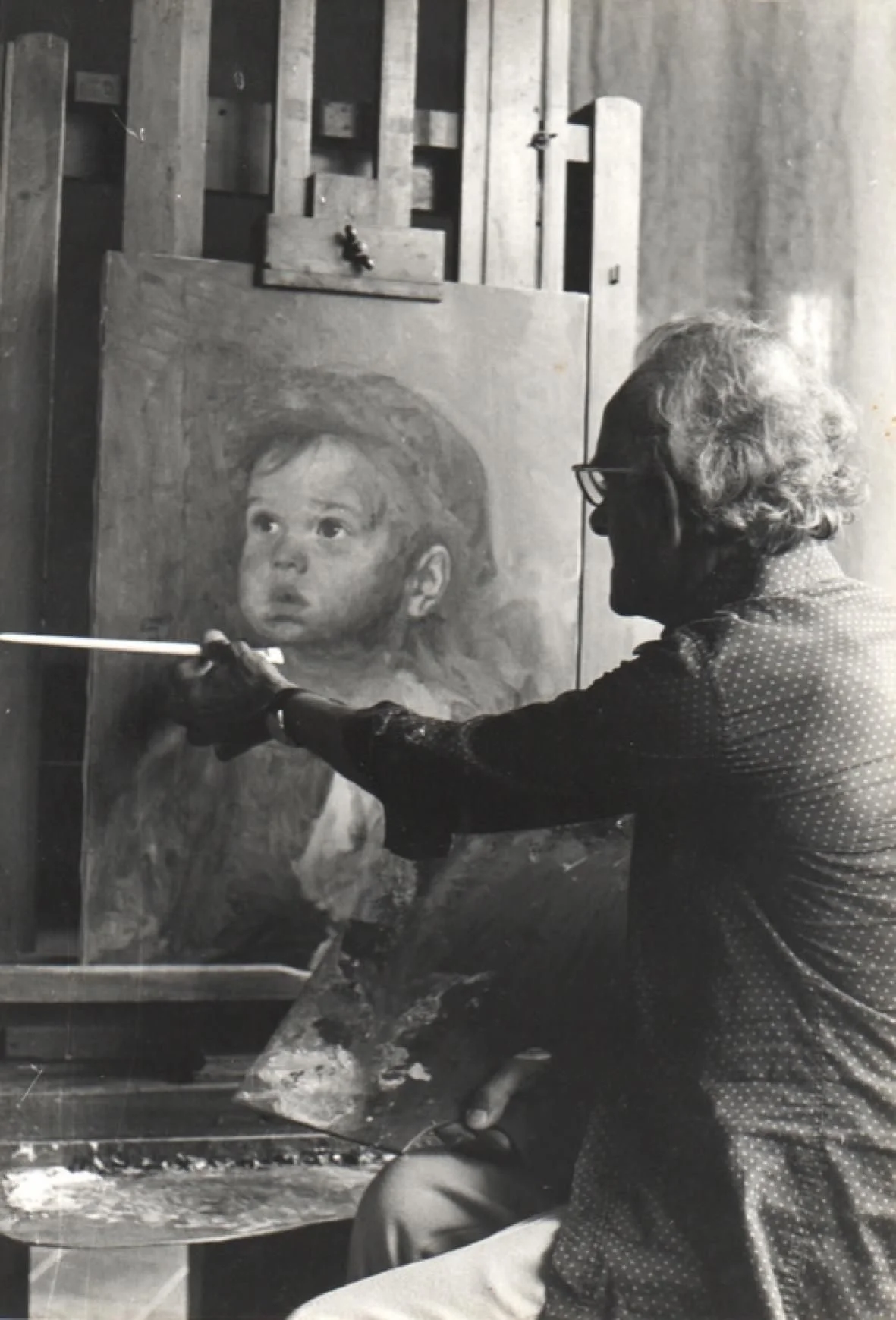
The best-known Crying Boy prints were attributed to an artist named Giovanni Bragolin, but that wasn't his real name.
The artist was Bruno Amadio, an Italian painter who also used the name Franchot Seville.
Amadio produced paintings of crying children, and reproductions became popular enough to be sold in large numbers. Estimates published during the original scare varied, with some reports claiming tens of thousands had been sold and others suggesting considerably more.
For years, information about Amadio was difficult to establish, and that uncertainty helped create several stories about the identity of the child in the paintings.
One of the most elaborate versions involves a Spanish orphan named Don Bonillo.
According to a story later published by Liverpool writer Tom Slemen, an artist named Franchot Seville encountered a young boy wandering through Madrid in 1969. The child supposedly never spoke and had an unusually sorrowful expression.
Seville decided to paint him.
But according to the legend, a Catholic priest recognized the boy and warned the artist to stay away from him.
The priest supposedly identified him as Don Bonillo, a child whose parents had died in a fire. The story claimed that mysterious fires followed the boy wherever he went, earning him the nickname El Diablo.
Seville ignored the warning and took the child into his home, where he continued using him as a model.
Eventually, according to the story, the artist's studio burned down. Seville blamed the boy for the fire, and Don Bonillo disappeared.
The legend doesn't end there, though.
It claims that in 1976, a car crashed near Barcelona and burst into flames. The driver was supposedly burned beyond recognition, but part of a driving license survived, identifying the victim as a 19-year-old Don Bonillo.
Now, this is one of those stories that sounds like it should be fairly easy to investigate because it gives us names, locations, and even a year for the supposed accident.
But researchers have been unable to establish that Don Bonillo existed or that the events described in this story actually happened.
And there's another problem.
The detailed Don Bonillo story appeared much later than the original 1985 newspaper reports.
Dr. David Clarke, who researched the Crying Boy legend using contemporary newspaper archives, traced this version to Slemen's writings around 2000. Clarke found no corroborating evidence for the boy's supposed life, the priest's warning, or the fatal car crash.
What can be established is that Franchot Seville was a name associated with Bruno Amadio.
That doesn't establish the rest of the story.
In fact, Italian investigator Massimo Polidoro later traced Amadio through a former neighbor, Antonio Casellato, who said he had known the painter personally.
Casellato described Amadio as a professional artist who produced the Crying Boy paintings because there was demand for them. According to Casellato, Amadio used the name Bragolin for these commercially successful works, borrowing a name that had belonged to an uncle involved in vaudeville.
Amadio died in 1981, several years before the British newspaper scare began.
So while the Don Bonillo story has become a major part of the Crying Boy legend, the available research doesn't establish that the supposedly cursed orphan was ever the subject of the paintings.
And the original fire reports don't require that story to explain how the curse became famous.
Because by October 1985, people were already frightened enough of the paintings that a national newspaper decided to organize something rather unusual.
The Halloween Bonfire
By the end of October, The Sun had been publishing stories about the Crying Boy for several weeks.
Readers had been sending their unwanted pictures to the newspaper, and eventually the offices were reportedly holding approximately 2,500 prints.
Apparently, the newspaper needed to do something with them.
According to accounts of the event, an early proposal involved burning the paintings on the roof of The Sun's London offices, but that idea was rejected after objections from fire authorities.
Instead, on October 30, 1985, reporter Paul Hooper transported two vanloads of Crying Boy pictures to a site near Reading in Berkshire.
There, the paintings were burned in a large bonfire.
The newspaper reported the event on Halloween, presenting the destruction as an end to the supposed curse.
And after that, the number of newspaper stories about the Crying Boy began to decline.
But the legend didn't disappear.
If anything, the newspaper coverage had given the painting a reputation that continued long after the original fires had been forgotten.
People still shared stories about copies surviving fires, and new explanations appeared for why the paintings were supposedly dangerous.
Some versions claimed that treating the picture kindly could bring good luck. Others suggested that hanging a Crying Girl beside the Crying Boy could protect a household from the curse.
And then there were the stories about the spirit of the child being trapped inside the painting, supposedly starting fires in an attempt to escape.
Those claims are part of the later folklore, rather than findings established by the original fire investigations.
So Was the Crying Boy Really Cursed?
This is where I think the story becomes especially interesting, because unlike a lot of supposedly cursed objects, we can actually trace much of the Crying Boy's reputation back to specific newspaper reports.
In 2017, Dr. David Clarke examined newspaper coverage held by the British Library and identified 38 articles about the Crying Boy published between September 1985 and April 1986.
He also interviewed people involved in the original reporting.
And one of the most interesting things he discovered was that the idea of a curse may have originated with the journalist who wrote the first local story.
John Murphy, the reporter responsible for the September 2 article in The Star, later explained that it was his interpretation of the firefighter's unusual account that introduced the curse into the reporting.
In other words, the firefighters had reported seeing the pictures survive fires, but they hadn't established that the pictures were supernatural or responsible for the damage.
That distinction became less clear as the story spread.
Clarke also examined how the legend changed over time, from reports about apparently fire-resistant pictures to elaborate stories involving an orphan, a painter, and a series of mysterious deaths.
And there's another investigation worth mentioning.
In 2010, comedian and journalist Steven Punt explored the Crying Boy legend for BBC Radio 4's Punt P.I.
During the investigation, he interviewed Jane McCutchin, who described a fire that destroyed her home in the 1980s. According to her account, the family escaped, but the house was devastated, and the Crying Boy picture survived.
Punt also tested a Crying Boy print with fire-safety researcher Martin Shipp.
During the experiment, the picture did suffer some damage, but the fire did not consume it in the way they might have expected. The researchers considered whether a fire-resistant coating could help explain the result.
That investigation, along with the fire service's explanation about hardboard, offered reasons why some of the prints might survive conditions that destroyed other household belongings.
But it didn't change the fact that people had reported these experiences, sometimes decades before anyone started investigating the legend in detail.
And that brings us back to the question of what was actually happening in those houses.
The fires were real. People lost their homes, and some were injured. Firefighters reported finding pictures of crying children among the damage, and several homeowners believed those pictures were responsible for what happened.
What the evidence doesn't establish is that the paintings caused the fires.
There is also no verified connection between the paintings and the story of Don Bonillo, and the different pictures involved in the reports weren't even necessarily made by the same artist.
So we have a series of real fires, a popular type of artwork, several people reporting an unusual coincidence, and a newspaper story that turned those reports into one of Britain's best-known modern curses.
And apparently, the story was good enough that even the editor of The Sun wasn't particularly interested in examining it too closely.
When former editor Kelvin MacKenzie was interviewed by Steven Punt in 2010, he acknowledged that he was superstitious and confirmed that he had once removed a Crying Boy print from the newspaper's office because he considered it unlucky.
He also suggested that investigating a good story too thoroughly could sometimes cause the story itself to fall apart.
Which is a pretty revealing thing to hear from the man whose newspaper helped make the painting famous.
Today, copies of the Crying Boy are still around. They appear in private collections, museums, and online sales, often advertised with references to the curse that made them famous.
And considering how many were sold in the first place, that's not particularly surprising.
But I do find it interesting that an inexpensive print, something thousands of families once bought simply to hang on their walls, became so closely associated with disaster that people were willing to send their paintings to a newspaper just to watch them burn.
The Crying Boy may not have started those fires, but the stories surrounding it certainly survived them.