
Is I4 haunted? Florida’s haunted Highway
Legend has it that I-4 is haunted. As you drive down a quarter-mile stretch of road near Sanford, Florida, people say you can sometimes see orbs of light crossing the highway. Others have reported seeing hitchhikers along the side of the road, but when they stop to pick them up, no one is there.
This particular stretch of interstate has become known as the I-4 Dead Zone, and people have been reporting strange experiences here since the road opened in the 1960s. It's also supposed to be one of the deadliest sections of the 132-mile interstate, which has itself repeatedly earned the unfortunate distinction of being one of the deadliest highways in the country.
But why? What is it about this particular section of road that supposedly makes it more haunted—or more deadly—than the rest of I-4?
To answer that, you have to go back almost a century before the interstate existed.
The Beginning—and End—of the St. Joseph's Catholic Colony
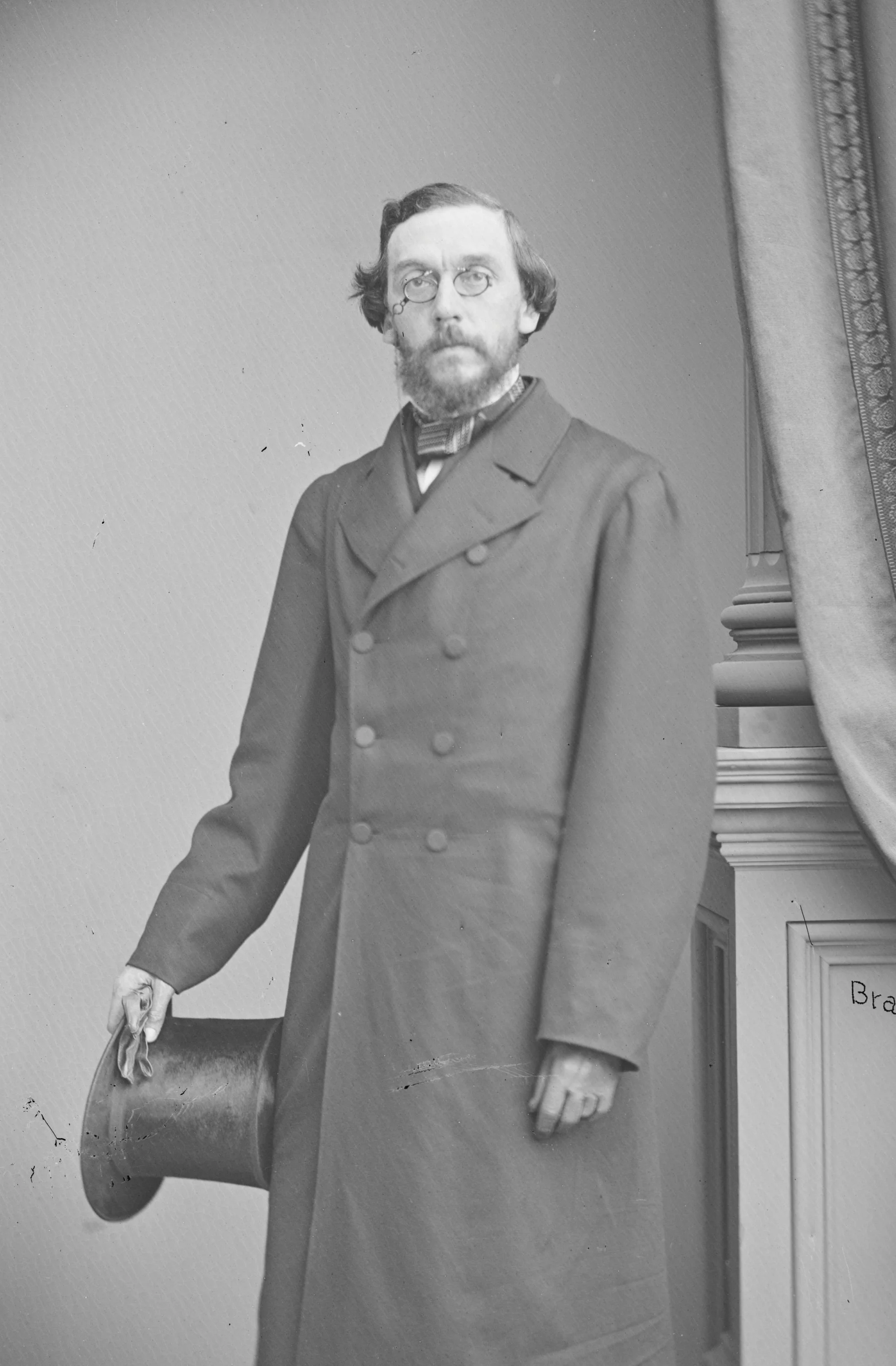
Henry Sanford 1823-1891 Att: By Mathew Brady Studio - https://npg.si.edu/object/npg_NPG.81.M1379, Public Domain, https://commons.wikimedia.org/w/index.php?curid=161332268
In 1870, Henry Sanford purchased about 6,140 acres of land along the shores of Lake Monroe. His plan was to sell some of that land to European immigrants and establish a Catholic community in the area. Father Swemberg, a resident priest assigned to the Orlando area, became involved with the community, and after a few plots were sold, a railroad was built nearby in the hope that easier transportation would encourage more people to settle there.
It didn't work, but not necessarily because there was anything wrong with the land. The timing was just terrible.

Aedes Aegypti mosquito
In 1887, two years after the St. Joseph's Catholic community was founded, yellow fever—also known as Yellow Jack—was making its way through Florida. The outbreak began in Key West and eventually spread into Tampa. At the time, people associated yellow fever with warmer months, but that was about the extent of their understanding of how it spread. Today we know that yellow fever is transmitted through the bite of an infected Aedes aegypti mosquito, the same mosquito that continues to make the news today for spreading diseases such as dengue.
Eventually, yellow fever reached the small St. Joseph's community and infected four people. Four cases might not sound like much until you realize that there were only four families living there, and all four people who became sick belonged to the same family.
Maybe an infected mosquito got into their home and bit several people while they were sleeping. We can't know exactly what happened, but the other families certainly didn't know what was causing the illness either. All they knew was that several members of one household had suddenly developed a potentially deadly disease.
So they packed up and left. And I don't mean they went away for a few weeks until things settled down. They left for good, almost as if there were something wrong with the land itself.
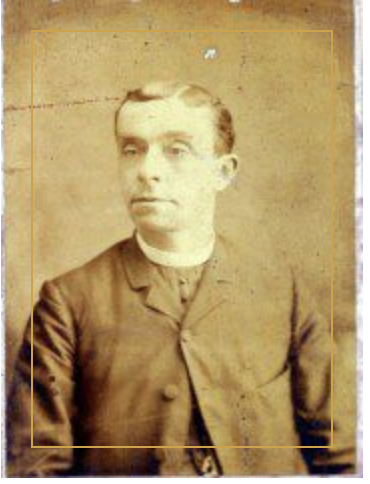
Father Swembergh
That left the infected family alone in an abandoned community. They called for Father Swemberg to come and administer last rites to the dying, but he never arrived. He had been called to Tampa a few days earlier to help administer last rites there, where the local priest had become sick. By the time Swemberg arrived, that priest was dead, and Swemberg himself contracted yellow fever and died only a few days later.
For a little context, last rites are traditionally administered to Catholics when they are dying, rather than after death, so that they can receive the Church's final sacraments. For a priest during a yellow fever epidemic, that meant repeatedly putting himself in close contact with people who were seriously ill at a time when no one yet understood how the disease was transmitted.
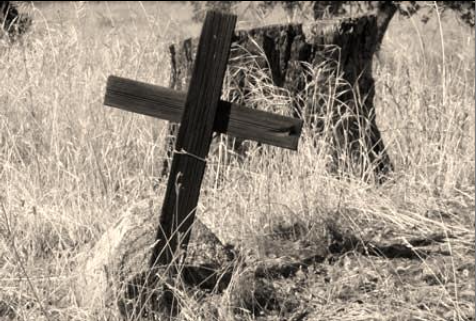
With the rest of the settlement already gone and their priest never coming, the surviving members of the last family eventually decided to leave as well. They buried their dead in the woods just north of the railroad tracks. There were no last rites. Wooden crosses were placed over the graves, and then the remaining members of the family packed up and left.
That was essentially the end of the St. Joseph's Catholic community.
The people disappeared. The graves didn't.
The Hawkins Family and the Field of the Dead
After the settlement was abandoned, the land changed hands a few times before being cleared and turned into farmland. Almost all of it was cleared, anyway. A small island of land where the four wooden crosses stood was left alone, with wire fencing placed around the graves to section them off from the surrounding fields.
The property was eventually sold to Albert Hawkins, who built a house near the edge of the cleared land and moved his family there. The Hawkins had seven children, which probably wasn't particularly unusual for a farming family at the time. More kids meant more hands to help around the farm. It also meant there were probably a lot of toys in that house, which made it easier to notice when those toys weren't where they were supposed to be.
According to the story, toys would randomly move around the Hawkins house. Things wouldn't be where the children had left them, or a toy would disappear for a few days and then suddenly reappear.
One day, Albert was walking through the fields when he came across the little burial island. By then, the wooden crosses were badly deteriorated. They'd been sitting outside for about 25 years, after all, and they were only made of wood. Not knowing much about them, Albert removed the crosses.
That night, a fire started in the Hawkins house.
Being superstitious—I mean, who wouldn't be when you already have toys randomly moving around your house?—Albert and his wife apparently couldn't help connecting the fire to what he had done earlier that day. He had removed the crosses from the graves, and that same night their house caught fire.
His wife made sure he put the crosses back.
Over the next 50 years or so, Albert rented portions of the fields to other farmers, but he reportedly gave them one very specific warning: don't mess with the graves. He probably told them what had happened when he messed with them himself, so the story would have been well known among the people working the property.
Eventually, one farmer decided he didn't believe any of the superstition and wanted to clear the burial area. He started by removing the wire fencing surrounding the graves. It wasn't more than a day later, according to the legend, that his house caught fire and burned to the ground.
At this point, a pattern was starting to form. At least in the story, every time someone disturbed those graves, something bad happened.
And then, in the 1950s, someone disturbed them again. By this point, the surrounding area had developed considerably. It wasn't just woods and farmland anymore, although patches of both still remained. One of the wooded areas that had been left largely untouched was the land around the graves near Lake Monroe.
One afternoon, a little boy was playing in the area and had the genius idea to dig up the graves. He started digging, but it eventually began getting dark and he had to go home. The following night, the boy was struck by a drunk driver and died from his injuries. The driver was reportedly never identified or caught.
Once again, someone had messed with the graves, and something terrible happened almost immediately afterward.
Locals began calling the area the Field of the Dead.
Then the government decided it was a good place to build an interstate.
Building I-4
Around this same time, the federal government was pouring money into the construction of interstate highways across the country, and Florida decided to build one connecting Tampa and Daytona Beach.
By then, Albert Hawkins had been dead for about a decade, and his widow eventually sold the property to the government. The hope was that the new highway—and the development happening throughout Central Florida—would bring more life and opportunity to the area.
Surveyors came through and marked where the new interstate would go. During that process, the graves were reportedly noted as being in the path of construction and needing to be relocated before work began.
No big deal. Move the remains, then build the road. Except that's not what supposedly happened.
When construction actually began, someone apparently decided the graves weren't important enough to hold up the project. Instead of relocating the bodies, the road was built over them.
And this is where Hurricane Donna enters the story.
It's September 1960, and a massive hurricane named Donna is moving toward Florida. Being Florida, hurricanes aren't exactly an unusual occurrence, and work doesn't necessarily stop just because there's a storm somewhere out there until the wind and rain become more of a concern than the normal afternoon thunderstorms.
According to the legend, on September 11, fill dirt was being brought into the area to raise the interstate to grade directly over the burial site. At the same time, Hurricane Donna, which had been expected to continue along a different path, changed direction after reaching Florida. The storm crossed the state, and the eye reportedly passed within about 10 miles of the graves.
Was that a coincidence? Probably.
But when you already have a local story about fires and deaths following anyone who disturbs four forgotten graves, and then a major hurricane changes course around the same time construction crews start burying those graves beneath an interstate, you can see how that detail became part of the legend.
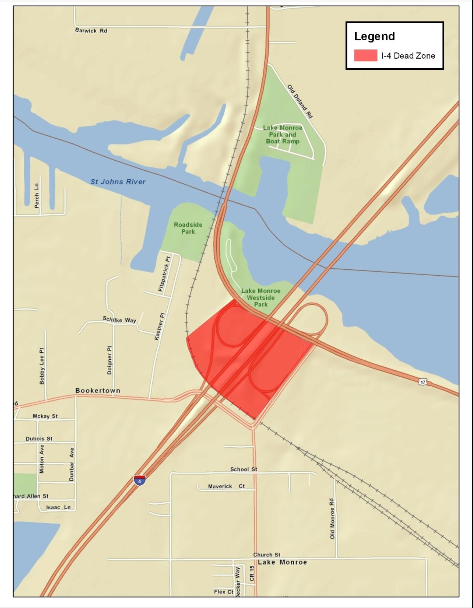
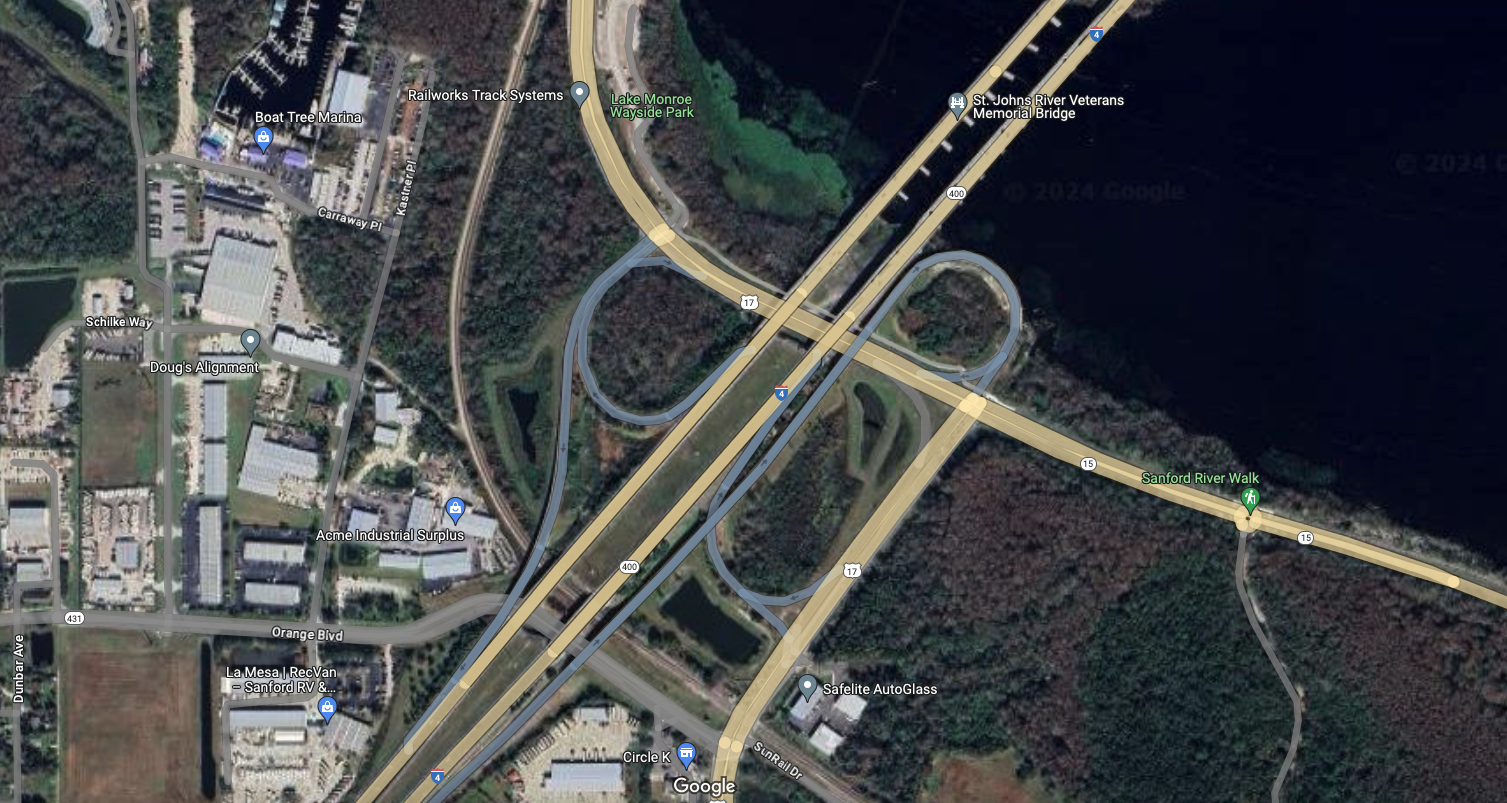
Red square is the I4 Dead Zone
The Dead Zone Gets Its First Victim
Fast-forward to 1963, when this section of I-4 officially opened. Imagine an 18-wheeler hauling frozen shrimp eastbound along the brand-new interstate. Everything is fine until the truck approaches the St. Johns River bridge, loses control and jackknifes. According to the legend, the driver didn't survive, making him the first victim of what would become known as the I-4 Dead Zone.
What caused him to lose control? I have no idea.
Locals, however, had an explanation. They said it was the ghosts of the four people buried beneath the highway. Depending on which version of the story you hear, the spirits may be trying to get people's attention, warning drivers about the graves, or simply taking revenge on the people now driving over them.
Either way, the reputation of the Dead Zone grew.
I-4 as a whole has repeatedly been described as one of the deadliest highways in the United States. Claims surrounding the Dead Zone sometimes say that there have been around 2,000 crashes there since the highway opened.
That sounds like a lot until you stop and think about the time involved. The highway opened in 1963. Spread across more than 60 years, 2,000 crashes averages out to somewhere around 30-something crashes per year.
And those are crashes, not deaths. That's an important distinction.
Is the Dead Zone Actually More Deadly?
This is where the story gets particularly interesting to me, because people like to play with numbers to make things sound more impressive than they might actually be.
One set of figures I found while researching said that hundreds of crashes had occurred in the area over several years. Then, in 2010, a regional planning council gave a presentation that included data about the I-4 Dead Zone.
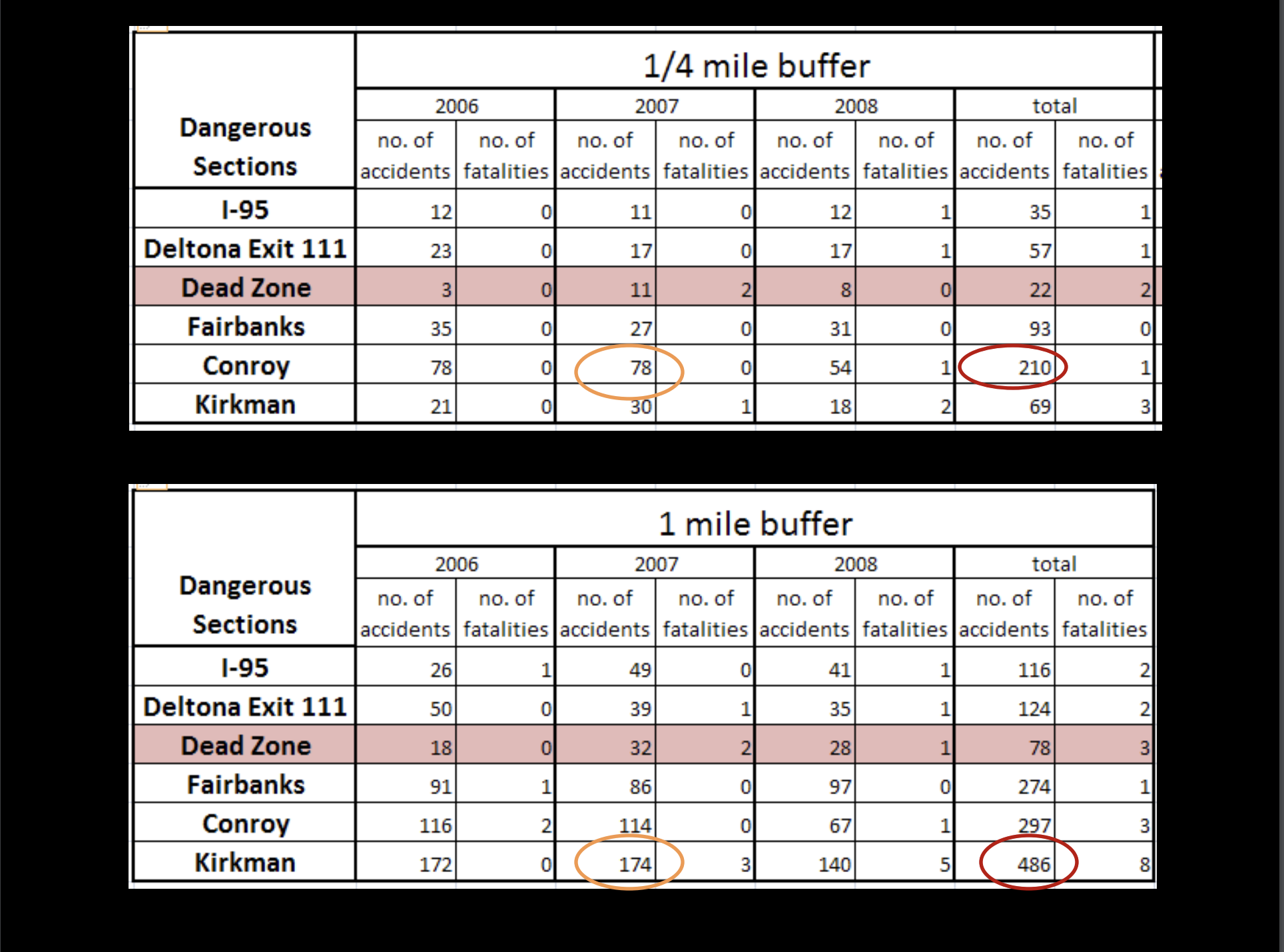
Data from the East Regional Planning Council presentation
Between 2006 and 2008, there were reportedly 22 crashes in the Dead Zone. Two resulted in deaths.
The presentation compared that section with other, busier areas that had more crashes and, unsurprisingly, more total deaths. But if you take the number of crashes in each area and calculate what percentage resulted in a death, the Dead Zone suddenly looks much more impressive.
Two deaths out of 22 crashes is roughly 9%.
That percentage was about double some of the other areas being compared.
So I could tell you that the I-4 Dead Zone had a fatal-crash rate twice as high as the comparison areas, which sounds pretty ominous. Or I could tell you that two people died there over a three-year period. It doesn't sound quite as impressive when I say it that way, does it?
Even the 9% sounds pretty good for a haunted-highway story until you realize how small the numbers behind that percentage actually are.
That's why I'm hesitant to point to accident statistics and say, "See? Ghosts." I-4 is busy. Central Florida has a lot of traffic. People make mistakes. Accidents happen. Even if the ghosts of the original settlers aren't causing crashes, though, that doesn't explain all of the other stories people have told about this stretch of highway.
The Strange Things Drivers Say Happen Here
People have reported that their phones and other electronics behave strangely as they pass through the Dead Zone. One story says that two people will be talking on the phone when they suddenly hear a third voice on the line. Could the signals simply be getting mixed up or distorted? Maybe.
There have also been attempts to explain these experiences using supposedly unusual magnetic activity in the area. I looked into this idea, and while paranormal theories involving electromagnetic fields are common, connecting that directly to modern cell phones doesn't make a lot of sense. Older electronics may have been more susceptible to certain kinds of interference, but modern phones use solid-state storage rather than magnetic hard drives. And, again, all of this is ultimately based on paranormal theories in the first place.
The disappearing hitchhikers are harder to explain simply because there's so little concrete evidence to work with.
Let's say you're driving east toward Sanford one night. As you approach the bridge, you notice a girl walking along the side of the road. You pass her and decide to give her a lift, so you slow down and pull over. Then you look in your rearview mirror. No one's there. You turn around in your seat and look through the back window. Still no one. Where did she go?
Versions of this story have reportedly been told by multiple drivers since the road opened, although no one seems to know who these ghostly hitchhikers are supposed to be. One theory is that they're the spirits of people who have died in accidents along this stretch of I-4 and are now trying to warn other drivers or get their attention for some reason.
Which brings us back to the ghost truck.
Remember the frozen-shrimp truck that supposedly jackknifed shortly after this section of interstate opened? Drivers have also reported seeing a truck along the Dead Zone that seems to disappear.
If people really are seeing a ghost truck in the same general area where that first truck stopped moving more than 60 years ago, could they somehow be seeing the same truck? Is it stuck in some kind of loop, replaying the same event over and over, except sometimes someone else happens to be on the road to see it?
I don't know. But it's a good ghost story.
The Hurricanes Come Back
Hurricane Donna changing direction when construction began over the graves isn't the only hurricane that has become part of the Dead Zone legend.
The ghosts supposedly did it again in 2004.
Hurricane Charley path as it related to the I4 Dead Zone
That year, the St. Johns River bridge was being expanded to add additional lanes, which meant more construction in the area surrounding the graves. Hurricane Charley hit Florida that August and made a sharp turn across the state, bringing the storm through Central Florida. Naturally, the legend connected the two.
Construction disturbed the graves again, so the ghosts influenced another hurricane to pass through the area. There is a fairly obvious problem with this theory. Florida gets hurricanes. I-4 gets construction. Those two things are going to overlap eventually.
When I originally made the video about the Dead Zone in 2024, construction had been happening in the area again since the previous fall. So, naturally, I had to ask what that meant for the upcoming hurricane season.
Were the ghosts going to send another hurricane because somebody was messing around near their graves again? Hopefully not. And since I'm writing this well after that hurricane season ended, I think we can safely say that four settlers buried beneath I-4 do not appear to control Atlantic hurricane patterns.
Still, that's the kind of coincidence that keeps a legend alive. Hurricane Donna passes close to the burial site when the highway is being built. Decades later, Hurricane Charley comes through while another major construction project is happening in the same area. If you already believe there's something strange about this place, those events are going to look connected.
If you don't, they're probably just hurricanes in Florida.
So, Is the I-4 Dead Zone Actually Haunted?
That's the part I can't answer.
Some pieces of the story have perfectly ordinary explanations. I-4 being dangerous isn't especially surprising. It's a busy interstate running through a heavily traveled part of Florida. Hurricanes crossing the state aren't particularly mysterious either, even when their paths change in ways people weren't expecting.
Other parts of the legend are harder to judge because they're stories that have been passed around for decades. A house supposedly catches fire after crosses are removed from the graves. Another farmer removes the fence and loses his house to a fire. A boy starts digging into the burial ground and is killed the next day. Drivers see people along the highway who aren't there when they stop. A truck appears and disappears near the place where another truck supposedly crashed when the road first opened.
Maybe all of those stories have explanations. Maybe some have been exaggerated over the years. Maybe some never happened exactly the way they're told now.
That's usually what happens with folklore. A real place and a real piece of history become tangled together with personal experiences, coincidences, retellings and details that are almost impossible to trace back to their original source.
But the part that originally caught my attention wasn't really the ghost truck or the disappearing hitchhikers. It was the graves.
A tiny Catholic settlement was established in the Florida wilderness. Yellow fever arrived. Four people from one family became sick, the surrounding community disappeared, their priest died before he could reach them, and the dead were buried in a little patch of woods marked by wooden crosses.
The settlement vanished, but for decades afterward people apparently knew those graves were there. Farmers worked around them. The land surrounding them changed. Central Florida grew.
Then I-4 came through. And according to the story, instead of moving the people who had been buried there decades earlier, the interstate was simply built over them.
Today, thousands of cars travel that stretch of road without the people inside them ever knowing what's supposedly beneath the pavement. Whether those four people are responsible for fires, accidents, phantom hitchhikers, disappearing trucks or hurricanes is another question entirely.
But if you've ever driven through the I-4 Dead Zone and experienced something strange, I'd genuinely like to hear about it. These kinds of stories become much more interesting when you can trace the legend alongside the experiences people are still having there.
And if nothing strange has ever happened to you there?
That's okay too.
Sometimes four forgotten graves underneath an interstate are strange enough.